AI Call Automation for Ophthalmology: Always on Access
Ophthalmology practices don't just handle urgent appointments—they manage thousands of recurring, high-frequency interactions that never stop.
Annual eye exams. Prescription refills for contact lenses and eye drops. Surgical consultation scheduling. Post-op follow-ups. Chronic condition monitoring for glaucoma and macular degeneration. Optical visits for new frames or contact lens adjustments. Insurance verification for procedures. Results calls after imaging.
Each call type follows different protocols. Each subspecialty—retina, cataract, glaucoma, general ophthalmology, ASC—has its own scheduling rules, appointment lengths, and patient flow requirements. And high-volume practices handling 200+ daily calls struggle to keep up—especially with an elderly patient base that prefers phone communication over digital channels.
Generic healthcare AI doesn't understand this operational reality. EliseAI does.
Since 2017, we've built agentic AI that doesn't just answer calls—it completes tasks. We started in housing, where in 2025, we sent 130 million messages on behalf of hundreds of operators and saved onsite teams over 10 million hours. In 2022, we brought that same task-completion approach to healthcare, and we've spent the last three years engineering workflows that understand how ophthalmology actually operates. OpenAI recently named EliseAI as a trusted partner for healthcare AI automation.
This isn't a chatbot that transfers calls to your staff. It's purpose-built call automation that schedules the appointment, verifies the insurance, logs the prescription refill request, and updates your EHR—all while the patient is still on the phone.
Here's how practices are using it.
Automating the Repetitive Calls That Dominate Your Front Desk
The majority of calls to high-volume ophthalmology practices fall into predictable categories: patients scheduling annual exams, requesting prescription refills for contact lenses or glaucoma medications, booking surgical consultations, asking about optical services, and following up on test results.
EliseAI's call automation handles all of these automatically.
When a patient calls to schedule their annual exam, the system checks their appointment history in your EHR, verifies insurance coverage, identifies available slots based on provider templates, and books the appointment—no staff intervention required. When someone requests a contact lens prescription refill, the platform creates a patient case, flags it for provider review, and confirms next steps with the patient.
This level of automation is only possible because our engineering team has mapped the specific workflows that dominate ophthalmology call volumes. We've studied how annual exam scheduling differs from surgical consultations. We've built logic for handling optical visits separately from medical appointments. We understand that prescription refill requests require provider approval before fulfillment.
Over 40% of after-hours calls are scheduling-related. EliseAI captures those appointments 24/7, ensuring you never lose revenue to patients who can't get through during business hours.
Insurance Verification Purpose-Built for Ophthalmology Procedures
Insurance in ophthalmology is procedure-specific. Routine eye exams are covered under different plans than cataract surgery. The platform distinguishes between vision insurance for routine exams and medical insurance for procedures—automatically routing patients to the correct coverage verification workflow. Certain procedures require prior authorization, others need referrals, and coverage varies by provider and location.
EliseAI's platform manages this complexity automatically, which is especially critical for elderly patients navigating complex Medicare Advantage plans and supplemental vision coverage.
During the call, the system prompts patients to upload insurance cards, runs real-time eligibility checks specific to the appointment type, identifies whether the procedure requires prior authorization, flags medical vs. vision insurance distinctions, and uploads everything into your EHR with no manual data entry.
The platform knows which procedures need pre-authorization. It knows which providers accept which plans. EliseAI's vision plan vs. medical insurance logic prevents billing errors before appointments are booked.
Subspecialty Routing That Understands Retina Isn't General Ophthalmology
Here's where most "healthcare AI" fails: treating all ophthalmology as one specialty.
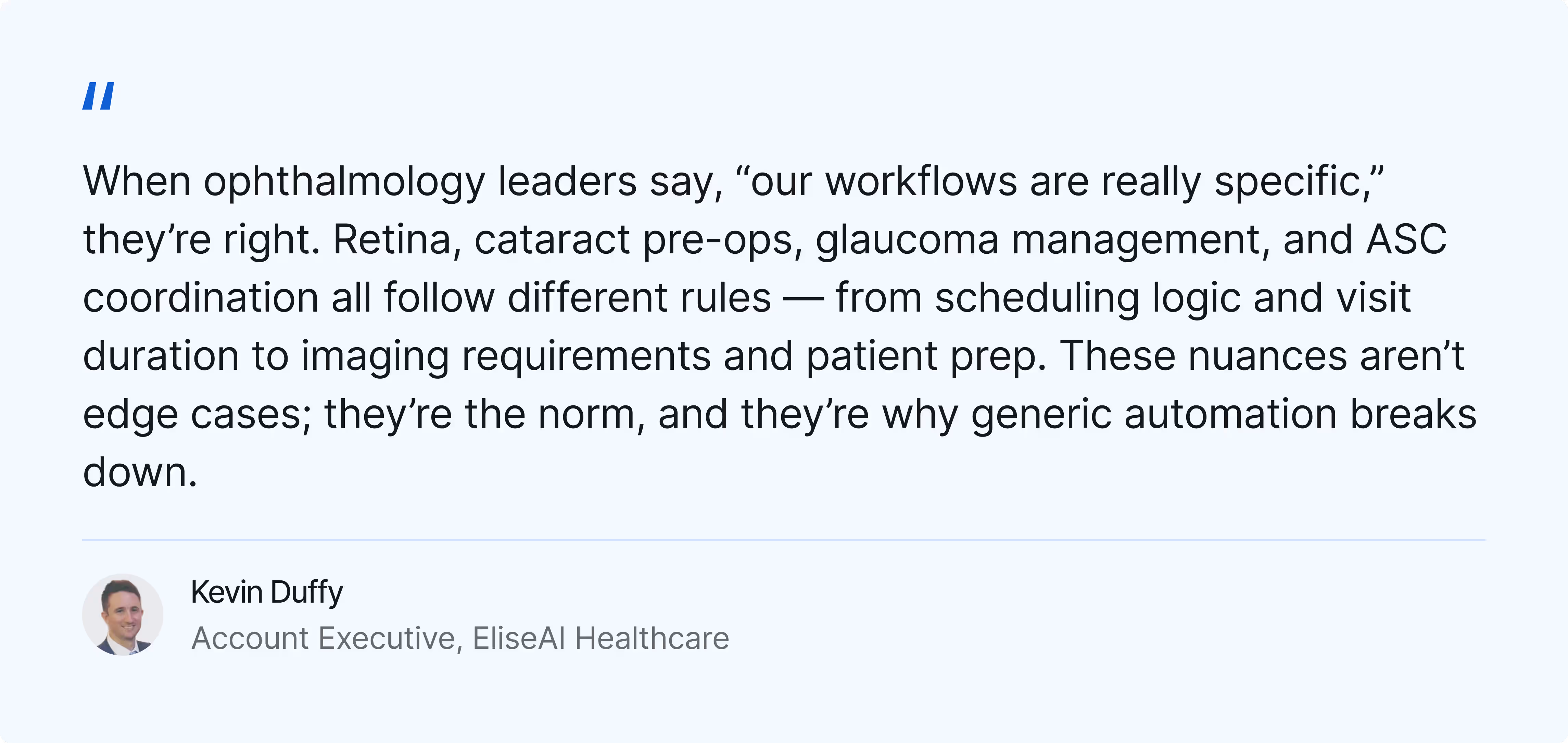
Practice managers know that retina workflows are fundamentally different from general ophthalmology. Cataract surgery scheduling follows different protocols than glaucoma management. ASC coordination requires entirely different appointment structures than routine eye care.
EliseAI routes patients based on the specific subspecialty they need. A patient calling about diabetic retinopathy gets directed to your retina specialist—not whoever happens to have availability. Someone scheduling cataract pre-op goes to the right provider with the correct appointment duration. Glaucoma follow-ups are routed based on continuity of care and chronic condition management protocols.
The platform respects provider-specific scheduling rules: appointment duration requirements by procedure type, subspecialty focus areas, new patient restrictions, ASC booking protocols, and daily patient caps.
This routing intelligence happens in real-time during the conversation. No transfers. No errors. No manual sorting later. We've engineered similar subspecialty-specific workflows for orthopedic practices (where complexity lies in sports medicine routing and workers' comp protocols), women's health (where dual appointments and continuity of care create scheduling challenges), and dermatology (balancing cosmetic and medical visits). Each specialty operates differently—generic healthcare AI treats them all the same.
Prescription Refill Management That Creates Provider Tasks Automatically
Call automation for prescription refill requests—whether for eye drops, contact lenses, or glasses—eliminates high-frequency, low-complexity calls that consume significant staff time.
EliseAI automates the entire workflow. When a patient requests a refill, the system authenticates the patient, identifies the prescription type and pharmacy, creates a patient case in your EHR flagged for provider review, and confirms next steps with the patient—all without staff involvement.
Providers review and approve refills through their existing EHR workflow. Patients get confirmation once the prescription is sent to their pharmacy. Nothing falls through the cracks.